There are two kinds of anxious moment, and most advice only addresses one of them.
The first kind lives in your head. The what-ifs, the worst-case rehearsals, the mental spreadsheet of everything that could go wrong. It speaks in sentences. You can argue with it, and sometimes you even win.
The second kind does not speak at all. It is the band across your chest on a Tuesday morning. The stomach that drops before you have consciously registered the meeting invite. The jaw you find clenched at traffic lights, the breath that sits high and shallow, the heart that picks up speed for no reason you can name. You cannot argue with this kind, because it was never making an argument.
If you have ever stood in your kitchen telling yourself, quite reasonably, that there is nothing to be anxious about, while your body carried on being anxious anyway, this article is about why that happens, and what tends to work instead.
Two Systems, Two Languages
Psychologists sometimes call these cognitive anxiety and somatic anxiety. In plain terms: anxiety as thought, and anxiety as body state. They are not the same thing, and they do not respond to the same tools.
But they are wired together, and the traffic runs in both directions. A what-if thought can set the heart racing, and a racing heart hands the mind fresh evidence that something must be wrong, which produces more what-ifs. Either one can start the loop, and the other will keep it spinning, which is why working on just one side so often disappoints. And here is a rule of thumb I have found reliable: the deeper into the body the anxiety has settled, the more real and visceral it feels, and the less it responds to being argued with. That is the territory where an indirect approach, working with state and experience rather than forcing thoughts onto the system, earns its keep. It is exactly where hypnotherapy shines.
Thought-anxiety runs on language and logic, which is why talking approaches can reach it. Body-anxiety runs on something much older: an automatic alarm system whose job is to get you ready for danger before you have had time to think. Racing heart to move blood to your muscles. Fast, shallow breath to load oxygen. Tense jaw and shoulders, braced for impact. A stomach that shuts down digestion because there are, apparently, more urgent priorities.
That is not a malfunction. That is a healthy protection system, doing exactly what it was built to do. The problem is simply that it is doing it in a meeting room in Rugby rather than in front of an actual threat, because somewhere along the line it learned to treat emails, social situations or Sunday evenings as danger.
Why You Cannot Talk Yourself Out of a Body State
Here is the uncomfortable mechanical truth: the alarm system fires faster than deliberate thought, and it does not take instructions in English.
By the time the rational part of your mind has composed its very sensible case, "this is only a meeting, nothing bad is happening", the body is already several seconds into its response. Adrenaline does not have a reverse gear that engages on request. Telling a body in full alarm to calm down is like emailing a smoke detector. The message is fine; the recipient does not read.
This is why willpower fails here, and why its failure is not a character flaw. Willpower is a tool of the deliberate mind, and in the moment of alarm, the deliberate mind is not in charge. If you have spent years concluding that you are weak because you cannot reason your way out of a racing heart, the kinder and more accurate conclusion is that you have been using the wrong tool with great persistence.
The same logic applies to the mental side too, by the way. I have written about why you cannot simply stop overthinking, and it is the same story one level up: patterns that run automatically do not yield to instructions.
The Alarm Is Not Broken. It Is Miscalibrated.
The lens I keep coming back to in this work: you are not broken. The system around you is running an old pattern.
Your alarm system learned its settings from experience, often years ago, sometimes decades. If it learned that criticism leads to humiliation, it now fires before every presentation. If it learned that conflict is dangerous, it now floods you in any tense conversation. It is working from outdated information with complete sincerity, like a smoke alarm that once saw a real fire and now goes off every time you make toast. And when the alarm has attached itself to one specific thing, a spider, a needle, a lift, that is a phobia, which is the same machinery with a very precise address; I have written about how phobias form here.
I see this constantly in working life. I have known people over the years, capable, likeable people, who kept repeating the same pattern at work: overreacting to small things, turning hostile in ordinary conversations, reading attack into a harmless email. You could watch it costing them, colleagues stepping carefully around them, opportunities quietly going elsewhere, and I doubt it switched off the moment they walked through their front door. The point is not that they were difficult people. Their alarm was firing at toast, over and over, and the whole cycle was unnecessary. Patterns like that can be unlearned, and watching one dissolve is one of the most satisfying parts of this work.
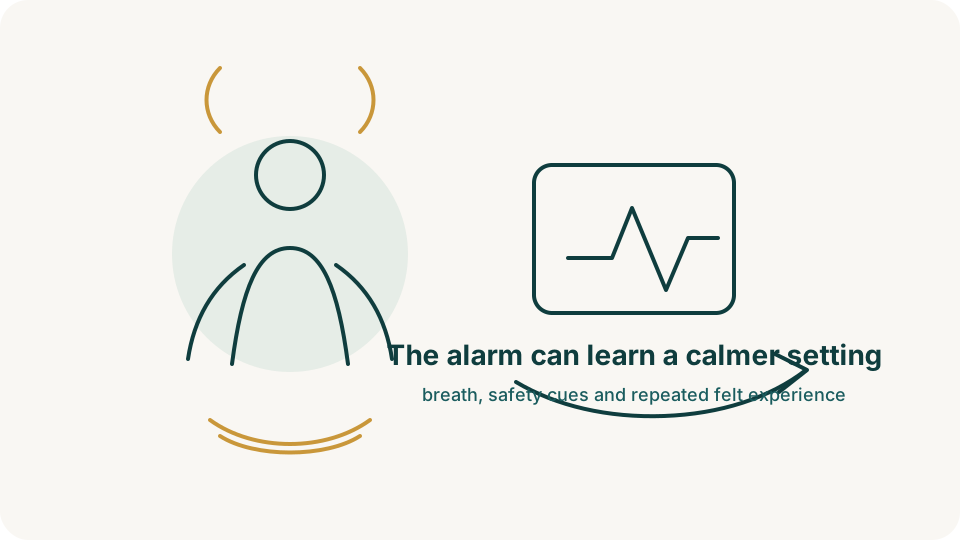
You do not sort a miscalibrated alarm by shouting at it, and you do not sort it by unplugging it either; you need it, it is what keeps you alert crossing the road. What the system needs is an update: new evidence, delivered in a language it understands, that the toast is not the fire.
That language is not logic. It is state and experience. The alarm system learns from what the body repeatedly feels, which is why the practice below works, and why approaches that work with the automatic layer, hypnotherapy and somatic approaches among them, can be useful here. In a session, guiding the system into genuine calm and then working with the old pattern from inside that calm is much of what we are doing. If you are curious what that looks like in practice, this is what a first session involves, and if you want the evidence picture first, I have written a short honest assessment and a deeper science page.
One Practice, Taught Properly: The Long Exhale and Orient
This is the settling practice I would teach you in a first session, in full. It uses two signals the alarm system actually reads: the out-breath and the eyes.
The principle. You cannot order your heart to slow down, but you can influence it indirectly. The out-breath is the body's built-in slowing signal: every time you exhale, your heart rate eases slightly, and a longer exhale leans on that natural brake. Slow, deliberate looking around does something similar: an alarm system that believed danger was present does not expect the eyes to move calmly around the room, and calm scanning tells it, in its own language, that the coast is clear.
Step one: sit and land. Sit down if you can. Feel the chair take your weight, and your feet flat on the floor. Let yourself be held by the furniture for a moment. This sounds trivial; it is the opposite. A braced body perches. A settling body lands.
Step two: exhale longer than you inhale. Breathe in through your nose for a count of about four, without forcing or gulping, and let the breath out slowly, through the mouth if that is comfortable, for a count of about six or seven. The exhale should feel like a slow deflating, not a push. If counting bothers you, just make the out-breath unhurried and noticeably longer than the in-breath. Do this for six to ten breaths. Important: do not strain for big in-breaths. Over-breathing winds the system up. The work happens on the way out.
Step three: orient. While your breathing continues gently, let your eyes travel slowly around the space. Actually look: the corner of the window frame, the colour of the door, the way light falls on the wall. Name three things silently and specifically: "blue mug, worn carpet, tree moving outside." You are not distracting yourself. You are giving the alarm system the sensory evidence it uses to decide whether danger is present.
Step four: check back in. After two or three minutes, notice your body again. Jaw, shoulders, stomach, breath. You are not looking for zero anxiety; you are looking for movement. From an eight to a six is a real result, and repeated regularly, it teaches the system something lasting.
How to use it. Twice a day, briefly, when you do not especially need it. This is the part people skip. A settling skill practised only mid-alarm is like trying to learn to swim during a shipwreck. Practise in calm moments, and the pathway is there, grooved and familiar, when the alarm fires.
Where This Fits, and Where to Get Proper Support
A practice like this settles the system in the moment. It does not, by itself, recalibrate the pattern that keeps setting the alarm off, which is where deeper pattern-level work comes in. If your version is less the sudden spike and more a background hum that never fully switches off, that is a close cousin of this pattern, and I have written about it in why the body stays switched on. If persistent pain is part of that background hum, I have also set out how I frame chronic pain and nervous system support alongside medical care. And one thing to say calmly and clearly: physical symptoms deserve respect. If you get chest tightness, a racing heart or persistent stomach trouble, it is sensible to see your GP and rule out physical causes, and if anxiety is weighing on your life significantly, your GP is the right first port of call. Hypnotherapy works alongside medical care, not instead of it.
Common Questions
If your anxiety lives more in your body than your head and you would like help working with the pattern behind it, this is what I do.
Adel Moin is a hypnotherapist and NLP practitioner based in Rugby, Warwickshire, with IPHM-accredited clinical hypnotherapy training. He works with clients dealing with anxiety, overthinking and confidence blocks, in person and online across the Midlands.