A warning before we start: almost every comparison you will find online was written by someone selling one of the three options, and it usually shows. The counselling site concludes counselling is best. The CBT clinic concludes CBT. The hypnotherapy page, remarkably, finds in favour of hypnotherapy.
I am a hypnotherapist, so hold me to the same suspicion. Here is my version of honesty in return: I will describe all three fairly, and I will not pretend to a neutrality I do not have. I have used all three from the client's chair, and hypnotherapy is the one that changed my life. So you will get the fair map and my honest opinion, clearly labelled as mine, and you get to weigh both.
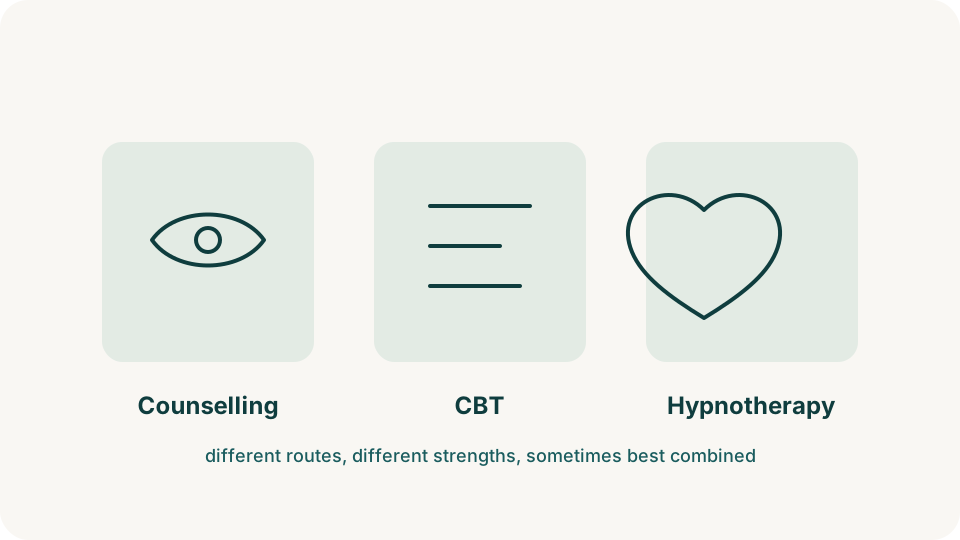
What Each One Actually Is
Counselling is a talking relationship. You bring what is troubling you to a trained listener who helps you explore it, make sense of it, and feel less alone with it. It is typically open-ended and led by you. Its power is in being properly heard, often for the first time, and in slowly making meaning out of difficult experience.
CBT, cognitive behavioural therapy, is structured and practical. It works on the link between thoughts, feelings and behaviour: learning to catch unhelpful thinking patterns, test them against reality, and change the behaviours that keep problems alive. It usually runs for a set number of sessions with exercises between them. It is the most heavily researched talking therapy and the backbone of NHS psychological treatment.
Hypnotherapy, as I use it, works with a focused, absorbed state of attention to approach automatic patterns: the habits, associations and self-beliefs that run without deliberate thought. Rather than only examining patterns from the outside, it tries to work with them from the inside. I have written a fuller account of the evidence in does hypnotherapy actually work, with the deeper research detail in what the science actually says.
A useful shorthand, slightly simplified: counselling helps you be heard and make sense of things, CBT helps you think and act differently, hypnotherapy aims to work with the automatic pattern underneath both.
One caveat before the comparisons, because it matters: the lines are softer in real rooms than on a comparison page. When someone talks through their week in CBT or counselling, they are talking about their patterns, and a skilled therapist of any stripe will step into that and work with the automatic habits underneath, whatever their method is called on the certificate. The differences here are about emphasis and starting point, not hard walls, and the best practitioners in every tradition reach beyond their labels.
Where CBT Fits, and Where I Part Ways With the Standard Advice
The standard advice goes like this: CBT has the largest evidence base, so start there. I used to repeat a version of that myself. I no longer think it is the whole truth, so let me give you both halves.
The practical half first. CBT is structured and transparent, you know within a set number of sessions whether it is helping, and in the UK it is free through NHS Talking Therapies. If money is tight, that matters, and I will never talk anyone out of free support that might help. It also suits people who genuinely like worksheets, measurable goals and homework.
Now the other half. "Largest evidence base" partly means "most studied", and what gets studied, funded and published is not a neutral lottery. Structured, manual-based therapies are easy to research and cheap to roll out, so they gather studies; approaches that are harder to standardise gather silence. And across the whole of health research, results that disappoint their funders are quietly less likely to see print. That is publication bias, a documented problem, not a theory of mine. So when someone says "the evidence says start with CBT", I hear "the volume of funded research says start with CBT", and I hold that more loosely than the standard advice does. I have written about how I read research, including where hypnotherapy's own evidence is thin, in what the science actually says.
Where does that leave you? If CBT appeals to you, take it seriously; the parts of it that work are genuinely worth having. I think enough of those parts that I bring elements of CBT and ACT into my own sessions, folded inside the hypnotherapy. What I will not do any more is tell you I think it is the better first choice for pattern-level problems. In my experience, from both chairs, it is not.
Where Counselling Fits
If what you are carrying is grief, a divorce, trauma you have never spoken about, or a life event that needs processing rather than solving, counselling offers something real: witness, time and a steady relationship. The same is true if you do not yet know what the problem is, only that something is wrong. Being properly heard changes how a problem sits, and I would never dismiss that; it is exactly what the first stretch of my own sessions is for.
The difference is what happens next. Being heard and making sense of things is the beginning of change, not the whole of it. When the moment comes for the pattern itself to move, that is pattern work, and pattern work is my territory. Plenty of people use both, in sequence or side by side, and it joins up well.
Where Hypnotherapy Shines
Now the honest case for my corner, which is a specific one.
Hypnotherapy earns its place where the problem is a pattern that keeps running despite understanding. The person who has done CBT, can recite their thought distortions, and still feels the dread. The person who knows exactly why they doubt themselves and doubts themselves anyway. The person whose overthinking or anxiety behaves like a reflex rather than a decision. When insight has not produced change, it can be worth exploring work with the automatic pattern, not because hypnotherapy is magic, but because that is the level the problem seems to be running on.
It also suits patterns that live partly in the body, the tension, the anticipatory dread, the gut that reacts before the mind does, because state work is native to it. The evidence, characterised modestly, is most encouraging for exactly this territory: anxiety-related patterns and some habit work, more mixed elsewhere.
What hypnotherapy is not: a substitute for specialist mental health care, a substitute for medical care, or a shortcut that asks nothing of you. If you are struggling significantly, your GP is the right first port of call, and hypnotherapy works alongside medical care, not instead of it. I will gently add one thing from years of watching people move through the system: stay an active participant in your own care. Appointments are short, and it is easy to walk out with a prescription and no conversation about anything else. Ask what your options are beyond medication, ask what else people with your difficulty have found useful, and remember that pattern work like this can run alongside whatever is medically right for you.
I Have Sat in All Three Chairs
Everything above could have been written from a textbook. This part could not, so take it for what it is: one person's real experience, not a promise about yours.
Over the years, working through my own difficulties, I have been the client in counselling, in psychotherapy and in CBT. Each gave me something worth having. Counselling taught me what it is to be properly heard. CBT handed me a map of my own thinking. And still, the approach that actually moved things, every time, was hypnotherapy. It is how I finally stopped smoking. It is what I stumbled into years earlier, before I even knew the word, when I somehow talked my own body out of its reaction to my cat; I tell that one with a smile rather than as a claim, allergies are a medical matter, but it planted a question that never left me. And it is what carried me through some genuinely heavy things life brought later, the kind that counselling had helped me talk about but not resolve.
So yes, I believe in my corner, openly: the way I practise it, hypnotherapy is the most direct route I have found to the automatic patterns underneath a problem. Weigh that against my obvious bias, test it in a free conversation, and do not let anyone, me included, tell you that your own experience of what works counts for less than a study.
They Combine Better Than People Expect
This is rarely said, because comparison pages want a winner. The three approaches can stack rather than compete. Plenty of people see a counsellor for ongoing support while doing focused pattern work with a hypnotherapist. CBT skills can pair naturally with the state work hypnotherapy teaches. If you do combine, tell both practitioners; joined-up work is better work.
For clarity, my core training is hypnotherapy and NLP. I also read widely across approaches like CBT, ACT and other modalities, and bring techniques from them into my own work where they genuinely help. I won't pretend reading around CBT makes me a CBT therapist. You get someone who studies broadly and stays honest about the difference between reading and training.
The Practical UK Picture
CBT and counselling: available free through NHS Talking Therapies, which you can self-refer to without seeing your GP first, though waiting lists vary by area and can be long. Both are also widely available privately.
Hypnotherapy: almost always private in the UK. That means shorter waits and more flexibility, but it costs money, and you should factor that honestly into the decision. It also means checking your practitioner properly: accreditation, insurance, supervision, and a willingness to tell you when hypnotherapy is not the right tool. Any practitioner who thinks their method fits everybody has stopped thinking.
How to Actually Choose
Here is the part that matters more than arguing about methods: across decades of therapy research, one of the most consistent findings is that the fit between you and the practitioner predicts outcomes about as well as the method does. A CBT therapist you trust beats a hypnotherapist you do not, and the reverse.
So choose in two steps. First, use the honest map above to pick the level your problem lives at: needing to be heard, needing new thinking tools, or needing pattern-level change. Second, talk to an actual human before committing. Most decent practitioners of all three kinds offer an initial conversation. Use it. Notice whether you feel understood or processed. If you want to know what that conversation looks like with me, this is what a first session involves, and this is my honest answer on session numbers.
Common Questions
If the pattern-level description sounds like where your problem seems to sit and you would like help working with it, this is what I do.
Adel Moin is a hypnotherapist and NLP practitioner based in Rugby, Warwickshire, with IPHM-accredited clinical hypnotherapy training. He works with clients dealing with anxiety, overthinking and confidence blocks, in person and online across the Midlands.