If a hypnotherapist starts talking about hidden switches and secret access to your mind as if that settles the science, be careful. Some of those ideas are useful metaphors in training rooms. That does not make them neuroscience.
There is a cleaner and more honest way to explain it. Hypnosis is a measurable state of absorbed attention. In that state, the brain seems to quiet some of the networks involved in self-monitoring, threat scanning and the constant commentary of "me, me, me". That matters because many of the patterns people bring to therapy are not really thinking problems. They are automatic responses.
Here is what I can show you, and what I cannot. I can show you that hypnosis changes attention and brain activity in ways researchers can measure. I cannot honestly tell you that a scan proves every clinical claim anyone makes about hypnotherapy. The useful bit sits between those two truths.
First, What Hypnosis Actually Is
Hypnosis is not sleep, not mind control, and not a theatrical loss of will. In therapy, it is the deliberate use of a focused, absorbed state where your attention narrows and the usual inner commentary softens.
Most people already know a lighter version of this state. You get absorbed in a film. You drive a familiar route and realise your mind was somewhere else. You read a page and the rest of the room fades for a while. Hypnotherapy uses that natural capacity on purpose, with a therapeutic direction.
My working model is this: hypnosis is a state of absorbed attention that can quiet self-monitoring and threat scanning, opening a window where automatic patterns may become easier to work with.
That is a model, not a claim that we have found a neat little filing cabinet in the brain where anxiety or confidence is stored. The brain is messier than that. The model is useful because it maps onto both the research and what people actually report in sessions.
What Brain Imaging Can Show
Brain imaging work on hypnosis has found three findings that matter in plain English.
First, activity drops in an area involved in salience and threat scanning. That is the system that helps decide what needs your attention, what might be dangerous, and what should be watched closely. When that settles, people often describe feeling less braced and less on guard.
Second, the connection strengthens between a control area at the front of the brain and the insula, a region closely tied to body awareness. That fits the clinical feel of hypnosis: attention, body state and suggested response become more linked than usual.
Third, the connection loosens between that control area and the default mode network, the network involved in self-referential thought, rumination and the constant story of "what does this mean about me?". Hypnosis is also broadly associated with decreased default mode network activity.
Put simply: hypnosis seems to quiet worry-scanning and self-monitoring networks. That does not make it magic. It makes it an altered state of attention that can be useful when the problem keeps running automatically.
Where Neuroplasticity Fits
Neuroplasticity just means the brain can change. It forms new associations, weakens old ones, and keeps learning throughout life. Every skill, habit and emotional response involves that basic capacity.
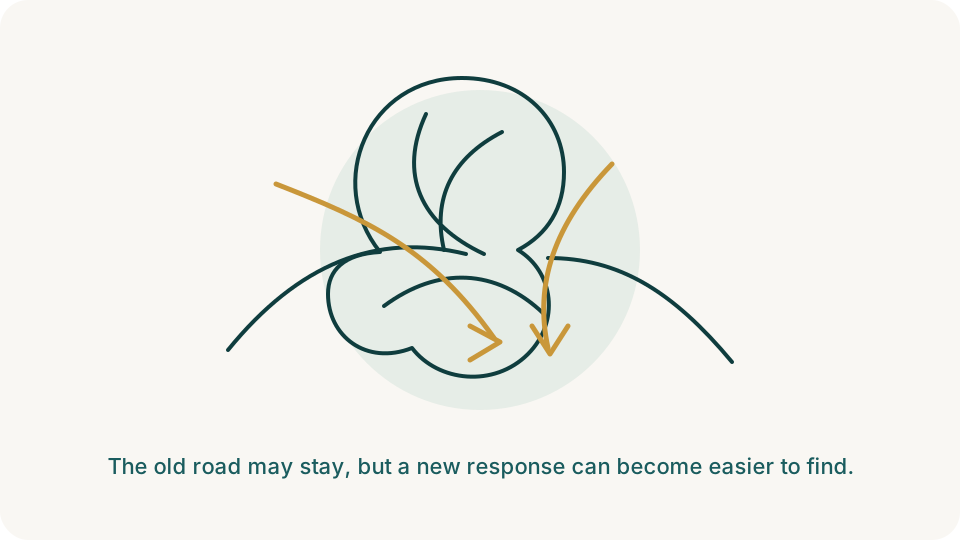
Hypnotherapy works with that ordinary capacity. The claim is not "one session rewires your brain". That is too neat and too salesy. The more honest claim is that when attention is absorbed and the old self-monitoring quietens, it may become easier to rehearse, feel and settle a different response.
That is why sessions are not just a nice conversation. We are often working with imagery, suggestion, memory, body state and rehearsal, all while the mind is less busy defending its usual story. For some people that can create a real shift. For others it is more gradual. Either way, it is still work, not a trick.
Why Willpower Often Struggles
Willpower is useful for some things. It is less useful when the pattern has already fired before you have had time to choose. Anxiety in the chest, the inner critic before a meeting, the habit you promised yourself you would not repeat: these often arrive as automatic responses, not considered decisions. Habits are the clearest everyday example, and I have written about why old habits come back under stress, which is this principle caught in the act.
This is why insight can be so frustrating. You can understand the pattern perfectly and still be living under it. Understanding lives in one part of the system. Automatic response lives in another. Hypnotherapy is one way of trying to bring those layers closer together.
Again, that is a working picture. It is not a promise. But it is a fair description of why this approach can make sense when someone has already thought, analysed and explained themselves to exhaustion.
What This Does Not Prove
The neuroscience does not prove that hypnotherapy works for everything. It does not prove that every practitioner is good. It does not prove that a particular number of sessions will get a particular result. It definitely does not mean hypnotherapy treats medical conditions.
Helping someone cope with a condition is not the same as treating the condition itself. That wall matters. If something needs medical diagnosis, psychiatric care or specialist support, hypnotherapy sits alongside that care or waits its turn. It does not replace it.
The research also leaves plenty of room for humility. Studies vary. Methods vary. Expectation plays a part in therapy, including hypnotherapy. That does not make the work fake. It means an honest practitioner should be careful about what they claim.
A Note on Research Itself
One more perspective, from someone who has spent time inside academia rather than only reading its outputs. My postgraduate degree came from a university with famously rigorous research standards, and that experience taught me two things at once: a deep respect for good research, and a clear eye for how much published work falls short of it. Small samples, weak designs, studies that look like science without being done to a standard I would accept. Research is also shaped by funding, and approaches that cannot be patented rarely attract the money that large, definitive trials require.
Hypnotherapy suffers particularly here, for one added reason: trials have to standardise, and hypnotherapy at its best is the opposite of standardised. A scripted, one-size protocol delivered identically to every participant is a fair test of that script. It is not a fair test of what a skilled practitioner does when the work is shaped around one specific person and their pattern.
So I hold both positions honestly. Research matters, and I would not want to practise without it. And the evidence that counts is wider than what has reached the journals so far: careful clinical experience, what clients report over months and years, and results that trials are not yet designed to capture. My own experience is that hypnotherapy done well is more powerful than the published research yet gives it credit for. That is not a reason to abandon the science. It is a reason to keep the scales balanced while the science catches up.
What It Means in Practice
For clients I see in Rugby and online, the practical question is usually simple: does the problem behave automatically? If it does, hypnotherapy may be worth exploring. Anxiety, overthinking, confidence blocks, habits and certain fear responses often have that quality. The person knows better, but the body or pattern has not caught up.
In sessions, we are not trying to overpower the mind. We are trying to create a state where the mind can stop guarding the old pattern quite so tightly, and begin to experience a different response as believable.
That is the most honest version I can give you. Hypnosis changes attention in measurable ways. That state can make automatic patterns easier to work with. It is not a guarantee, and it is not a cure-all. It is a useful doorway when the thing you are trying to change sits deeper than deliberate thought.
If you want the fuller research picture, including the anxiety figures and where the evidence is thin, I have put that in what the science actually says about hypnotherapy. If you want the practical version of what this feels like in the room, start with what to expect in your first session.
Adel Moin is a hypnotherapist and NLP practitioner based in Rugby, Warwickshire, with IPHM-accredited clinical hypnotherapy training. He works with clients in person in Rugby and online across Coventry, Birmingham, the Midlands and the rest of the UK.