Three good weeks. Maybe five. The nails growing back, the vape in a drawer, the evenings that no longer end with the snack cupboard or the doomscroll. You were quietly starting to trust it.
Then one properly hard day, the kind that arrives without warning and stacks itself on top of a bad night, and you surface an hour later mid-habit, hand in the biscuit tin, thumb on the screen, nail already bitten. And along with the habit comes the verdict: back to square one. No willpower. Typical me.
I want to take that verdict apart, because it is wrong in an interesting and useful way. Habits coming back under stress is not evidence of a weak character. It is the predictable behaviour of a well-built system, and once you see how it works, both the relapse and the way forward look different.
A Habit Is Wiring, Not Character
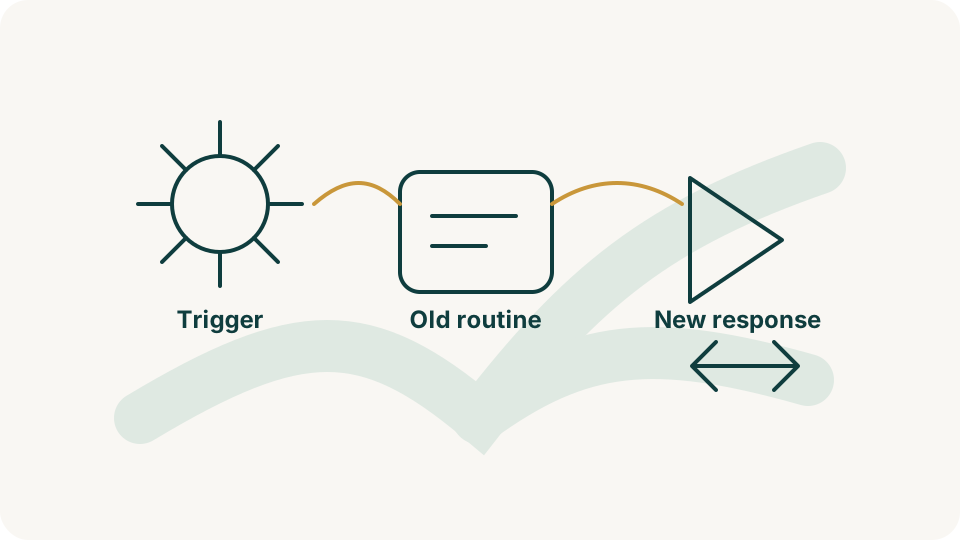
Every habit runs on the same simple loop: a cue, a routine, a payoff. Stressful email, hand to mouth, small relief. The loop is not stored in the part of you that makes decisions and holds intentions. It lives in older machinery whose whole job is automation: taking anything you repeat and making it run without you, so that thinking is saved for things that need it.
That machinery is a gift almost all of the time. It is why you can drive to work while planning dinner. The catch is that it does not evaluate what it automates. Repeat something often enough, with a payoff attached, and it gets wired in, whether it serves you or not. I have written more about how the brain builds and rebuilds these patterns, but the short version matters here: when you build a new habit, the old wiring does not get demolished. The brain keeps the old motorway. You have just built a quieter road beside it.
What Stress Actually Does to the Steering
Holding a new behaviour in place uses the deliberate mind: noticing the cue, remembering the intention, choosing differently. This is real work, and it runs on a budget. Stress, tiredness and emotional load all spend from exactly that budget.
So on the hard day, the resources that were supervising the new road are pulled away to deal with the crisis, and the system falls back to whatever is cheapest and most rehearsed. That is the old motorway, every time. Researchers have shown versions of this for years: under pressure, behaviour shifts from goal-directed to habitual. Not because you stopped caring, but because the part of you that carries the caring was busy.
There is a second mechanism, and it is the one people miss. The habit was never just a behaviour. It was doing a job. Soothing, punctuating the day, discharging tension, giving your hands something to do while your mind coped. Remove the habit without filling the job, and the vacancy sits there quietly. Stress reopens it with a flourish, because stress is precisely the state in which the job, comfort, relief, escape, most needs doing. If your system is running switched on more days than not, the vacancy is open more often than not too, which is why working with the stress pattern itself is often part of habit work.
I Know This Loop Personally
None of this is theory for me. I struggled with cigarette addiction, and at another point in my life with video games quietly swallowing whole evenings. I know the three good weeks. I know the hard day. And I know exactly which conditions blow the new road away, because I lived in them: I spent years in the supply chain world, working late shifts and rotating shifts in warehouses, one week on days, the next on nights, my sleep permanently scrambled. I also demanded a great deal of myself in that work, usually more than the job demanded of me. That combination, high standards, high load, wrecked sleep, is a relapse machine. The system never gets a calm week to bed the new pattern in, so the old motorway stays the only road that is always open.
If your life looks anything like that, shift work, deadlines stacked on deadlines, sleep that never settles, then hear the reframe in this article twice as loudly: your relapses are not a character report, they are what any nervous system does under those conditions. Robert Sapolsky wrote a whole book, Why Zebras Don't Get Ulcers, about what long-running stress does to bodies designed for short bursts of it. We are not built for the always-on load, and our habits are one of the places that shows first.
Why Trying Harder Is the Wrong Tool
The standard response to a relapse is to tighten the grip: more discipline, stricter rules, a sterner inner voice. I understand the instinct, and it tends to fail for the same reason affirmations tend to fail: it aims words and effort at a layer that runs on neither.
The urge fires before deliberation gets a say. By the time you are aware of wanting the thing, the automatic layer has already voted. White-knuckling can override it, sometimes for weeks, but it is expensive, and the budget it spends from is the first thing stress drains. A strategy that only works when life is calm is not much of a strategy for a habit that feeds on the opposite.
And the sterner inner voice quietly makes things worse, because shame is itself a stressor. Feel bad about the habit, and you have added load to the exact system that produces the habit. Many people are effectively running the loop with a whip in one hand and the biscuit tin in the other.
A Relapse Is Data, Not a Verdict
Here is the reframe I offer clients in Rugby, and it is practical rather than consoling: the good weeks were not erased. The new road you built is still there; nothing about a bad day deletes learning. What the relapse gives you is a map reference. It shows you, with great precision, which cue still owns you, which state opens the door, and what the habit is still being asked to provide.
So instead of the verdict, ask three questions of any relapse. When exactly did it happen? What was going on in the ten minutes before? And what did the habit give you in that moment, however briefly? Comfort, relief, distraction, a pause. Answer those honestly and you know what the work actually is. It is rarely stopping the behaviour. It is meeting the need some other way, and retraining the moment where the cue hands over control.
One Practice, Taught Properly: The Fifteen-Second Fork
This is for the live moment, when the urge has just fired. It is deliberately small, because anything demanding fails exactly when you need it.
Step one: name it, without argument. The moment you notice the pull, say silently: there is the pattern. Not stop, not no, not here we go again. Just a calm sighting, the way you would note a bus going past. Naming moves you from inside the urge to alongside it, and that small shift is the whole foundation.
Step two: one long exhale. Breathe in normally and let the out-breath run slow and unhurried. One breath. You are not trying to make the urge vanish; you are buying the deliberate mind a seat at the table, because urges surge and ease in waves, and even a few seconds changes what happens next.
Step three: ask what the job is. Silently: what is this actually asking for right now? A break. Comfort. A moment of not thinking. The answer is usually one word, and it is usually not the biscuit, the nail or the screen.
Step four: choose, in either direction. If you can meet the real need in some small way, do that: two minutes outside, a glass of water, a text to someone easy. And if you go ahead with the habit anyway, do it deliberately, with full attention, having chosen it. This sounds like a loophole. It is the opposite. A habit performed consciously is no longer running on autopilot, and autopilot is the thing you are actually dismantling.
What to expect. You will forget, then remember halfway through the habit. Fine: name it then. The fork is not about winning every time. It is about turning an automatic handover into a visible moment of choice, more and more often, until the old motorway starts growing grass.
And a note on step four from my own history, because I was once the person trying to sort everything at once: every habit, every flaw, all of it, this month. That is overwhelm dressed up as ambition, and it feeds the very stress that feeds the habits. Choose one thing, one thing only, and block the rest out for now. Make a plan you can actually keep, act on it, and be patient and genuinely kind with yourself while it takes hold. The rest of the list will still be there, and it will be lighter than you think: sort one pattern properly and several others tend to loosen on their own, because they were connected underneath.
The Stress Underneath the Habit
A few honest things about the stress side, since it is half of this story. When people take everyday stress to their GP, the advice that usually comes back is to meditate, exercise, slow down. Some people scoff at that. I do not, and honestly, if the first answer to ordinary stress were a prescription, I would be more concerned, not less. The natural approaches are the right family of approaches. What I will add is that hypnotherapy belongs in that same family and, in my experience, punches well above its weight in it: many people are surprised how much accumulated stress a single session releases, and the deeper work then goes after the patterns that keep regenerating it.
Because here is the thing about stress that took me years to understand: it is not only about what is on your plate now. It is also about what came before. Old patterns, old pressures, sometimes older wounds, quietly decide how much each new load weighs. Two people carry the same week completely differently, and the difference is history, not strength. That deeper layer can be processed, gently and at your pace, and doing so changes everything downstream of it.
And one reframe worth keeping: in the right dose, and held with the right mindset, stress is not your enemy. Research on stress mindset points the same way; how you relate to pressure changes what it does to you. Get the load realistic, process what sits underneath, and stress starts behaving differently: it turns up as energy when you need to perform, and it lets go of you when the work is done. That, rather than a stress-free life, is the goal worth working towards.
Where Deeper Work Comes In
Everything above you can do alone, and it helps. Where hypnotherapy earns its place is the layer underneath: rehearsing the new response in a calm, absorbed state so it is grooved before the hard day arrives, and working directly with the job the habit has been doing, so the vacancy actually gets filled. That is the heart of how I approach habits, smoking and vaping support, and if you want to see the process from the inside, this is what a first session involves.
This is also where the coaching side of my work earns its place. I know first-hand what it is to be driven, to hold targets you refuse to lower, and to keep discovering that a human body has limits your ambition never agreed to. So with clients working on habits, performance and direction, part of my job is exactly that balance: making sure you are not letting yourself off the hook, and making sure you are being realistic with yourself. We make a plan, you execute it, we adjust honestly as life happens, and the aim from day one is that you end up standing on your own feet, running the system without me.
One honest boundary: some habits sit on top of dependence or distress that deserves medical care. If alcohol, medication or another substance is involved, or if a habit is tangled up with low mood or anxiety that weighs on your life, talk to your GP as well. Hypnotherapy works alongside proper support, not instead of it.
Common Questions
If a pattern keeps coming back no matter how many times you quit it, and you would like to work on the layer where it actually lives, this is what I do.
Adel Moin is a hypnotherapist and NLP practitioner based in Rugby, Warwickshire, with IPHM-accredited clinical hypnotherapy training. He works with clients dealing with habits, smoking and vaping, stress, anxiety and overthinking, in person and online across the Midlands.